Tuesday, 13 January 2015

Landscape Art and Frederic Edwin Church


Landscape art can be elusive. In any art exhibition that aggregates paintings from a variety of genres, those with the subjects of clouds, mountains, trees, forests, river, ocean etc. are very likely the least interesting ones for the most ignorant of gallery-goers, who might, however, still notice the vivid colours and the superb brushworks before hastening on towards the more popular showstoppers. Colours and brushworks- the only attributes those viewers can recall of the paintings that quickly become no more than a passing memory, almost negligible in their perceived role of acting as a foil to the more notable masterpieces.

Our instinctive apathy towards landscape painting might be partly ascribed to the general ignorance of Nature. History testifies to how precious little do we know of the nature we’ve inhabited, how frequently such wanting of knowledge abets the selfish ones to gratify their avarice at the expense of the harmony amidst all living souls. Every voice in Nature is unanimous in pleading for mercy, but men heed not. Modern civilisation destroys totally the tenuous bond we still share with our Mother Nature. There is hardly a plot of land extant on earth that is not smeared with the footprints of humankind. The nature we know now is far removed from the paradisiac kingdom of yore- the purity is irrevocably corrupted, the beauty ruthlessly tainted.

Possession comes in various forms. Photography, in many ways, proffers an advisable means of possessing nature whilst leaving it intact and unharmed. Viewing for the first time a framed photograph of Mount Everest must be one of peculiar excitement. People are no longer obliged to go through an extremely hazardous, toiling expedition on the sole purpose of catching a glimpse of the mountain’s formidable presence. They can now enjoy the beautiful spectacle in an exhibition hall, or even in their drawing room. The incontestable verisimilitude between Mount Everest and that in a well-produced photograph- though, of course, the mountain is considerably smaller in scale- gives the ownership of the artwork an undertone of meaning not dissimilar to the possessiveness of a greedy entrepreneur. Moreover, by imprisoning the mountain with his camera the photographer guarantees its immortality. Such possessiveness thus smells faintly of narcissism.

The advent of photography, regardless of how it is possibly the only art form that successfully blurs the boundary between art and reality, undermines somewhat the novelty and innocence that are inherent in its more archaic counterparts. In regard to the portrayals of nature especially, photography is no match for painting.

My hitherto ignorance for landscape painting was to change when I first lighted on the paintings of Frederic Edwin Church. As a pupil of the renowned American landscape painter Thomas Cole, Church became one of the leading figures of the Hudson River School, a mid-19th century art movement founded by Cole, whose portrayals of American wilderness were profoundly influenced by the idealised vision of Romantic landscape art. Like many landscape painters of his contemporary and the succeeding generation, Cole had a penchant for the synthesis of nature and allegory. Church diverged from his teacher by giving the allegorical themes a wide berth and restricting his entire oeuvre to the depictions of nature. This decisive break from the norm was arguably one of the reasons Church was criticised for lacking an imaginative and spiritual flair in his handling of subject.

But is the aforesaid a justifiable verdict of Church’s paintings? There is an unwritten law for every novice reader of landscape painting to always delve into the tiniest detail and facts, regardless of how inconsequential they might be comparing to the whole. In The Heart of the Andes (1859) it is the little grave on the lower left of the painting. Not much effort will be needed in ferreting out this tiny feature as the sun kindles the grave to a gentle, noticeable glow. In the vicinity of the grave is a small waterfall which is almost transmuted into a cloud of white fume as it plunges into the water. The water is so emphatically rendered that we can virtually hear its rumbling roar. Our eyes then skim through the birch trees, the rocky plains, the magnificent mountains, and the snow-capped mountains in the far distance. Who said Church’s art was bland and unspiritual? Unlike any typical landscape painting, the pivot of Church’s is neither the mountains nor the trees nor the plains. Rather, it is that little grave- a gem embedded within the hovering nature, a lull against the excited hubbub. These harmonious juxtapositions of contrasts stimulate the painting to life.


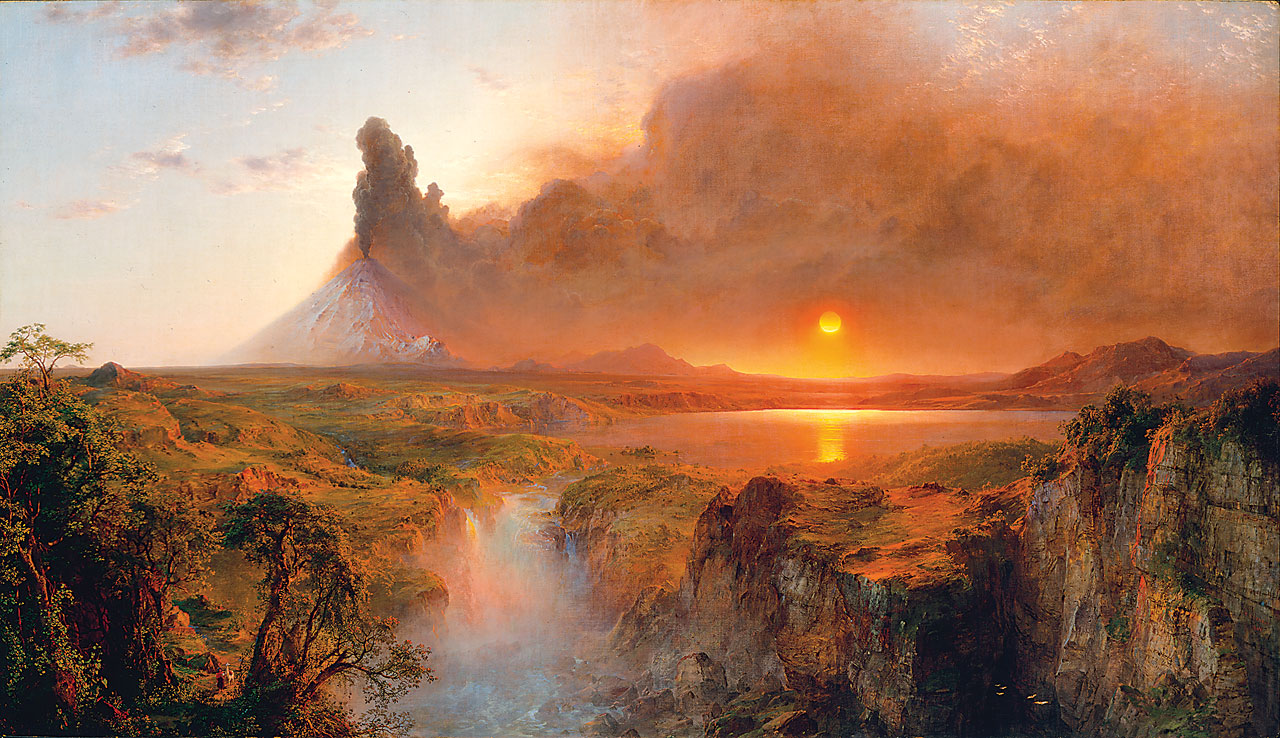
Nature can have its dramatic moments. Church made sure he always had the dark palette ready when he encountered one of Nature’s shrewish tempers. The volcanic eruption is always an apt subject for the landscape painters to demonstrate their proficiency in tackling a more theatrical theme with a more monumental scale. English painter John Martin recognised a correlation between volcanoes and the stories in Revelation. His many depictions of the erupting volcanoes are to be seen as a retelling of the Revelation tales set in a growingly industralised England, which is swamped by the boiling magma of human destructions. Whilst Martin’s vision was bleak and unrelenting, Church could not seem to rid himself off the Romantic influence that is implicit in a majority of his works. In Cotopaxi (1862) the spectacle of a volcanic eruption has the same beauty as a flaming sunset. Curiously, a sun can be perceived dwelling upon the horizon, distinguishing itself out of an expanding throng of black smoke. In common with the little grave in Heart of Andes, Church was wont to create a pleasing sense of quietude amidst the chaos. I see the painting not so much a bravura of unmitigated horror as that of Martin’s. Instead, I see the fluid brushwork, the soft nuances of colours, the brilliant interplay of light and shade, and the hint of a possible hope glimmering in sheer desolateness.


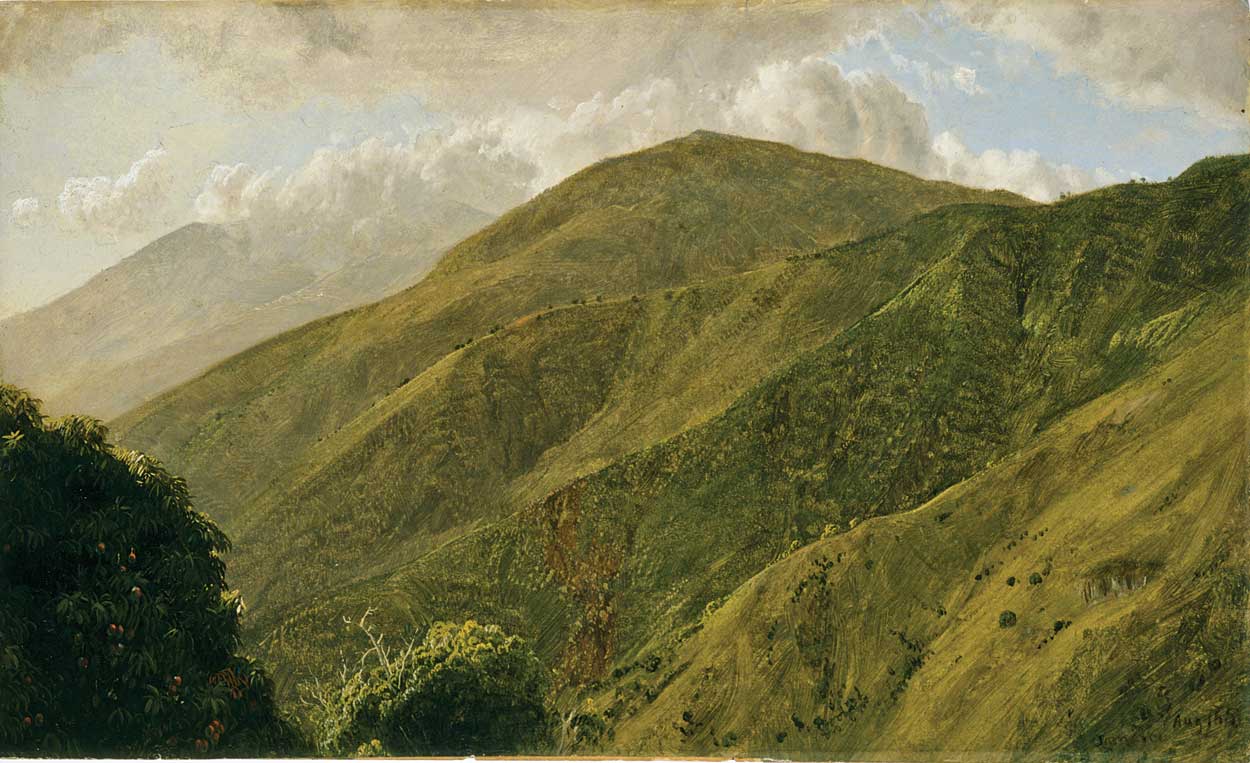
Church’s laudable effort in preserving the purity of nature did not, however, make his landscape paintings any less elusive. There are, within his sprawling oeuvre, works that one knows not how to make of, but can only admire the more obvious features like forms and colours.Scene in the Blue Mountains, Jamaica (1865) belongs to this sort of paintings. One struggles to no avail in grasping at a more precise and critical appraisal of the painting without yielding to a merry-go-around of banal enumeration of facts like the dangerously steep mountain ridges, a wide spectrum of green from yellow-green to forest-green, the ingenious lighting effect that helps create the distance-diminished detail...


Landscape paintings are an acquired taste but their importance is by no means any inferior to those of other subjects. Their elusiveness is the very incentive that spurs us on to keep looking.

Sunday, 2 November 2014

Review: Jean Fautrier, The National Museum of Art, Osaka, Sep. 27- Dec. 7, 2014


A sense of disquiet occasioning in the viewers exacerbated when they found themselves in an exhibition room that was almost unpeopled- quite normal I suppose for a Wednesday afternoon- and under the incessant, rigid vigilance of stiff-backed custodians, who seemed unnecessarily outnumbered for a show so small. Small-scale, though, there were at least 100 paintings waiting to be beholden, to be confronted by whomever that had no apprehension of what they were going to see. We felt our ignorance jeered upon, our forbearance sorely tested. The sights that passed through our eyes were atrocious, relentless, bewildering. Once we hastened out of the exit, still stunned with the horrors we could not yet comprehend, how we wished we hadn’t subjected ourselves to such ordeal, in a supposed-to-be glorious afternoon.

But we should have been cautious in advance of the ordeal, because this was a Jean Fautrier’s retrospective we were attending. Jean Fautrier, a French-born artist whose life was punctuated with calamitous events: two World Wars, the Great Depression, the Occupation, dedicated his artworks chiefly to the unique portrayals of pain and ugliness. The exhibition began with his early realism works, the result of his academic training is apparent, but from which influence there are telling signs that he was desperately trying to refrain. Fautrier had the license to rebel. There was this portrait of a concierge, her head was ill-formed and lumpy; she managed a smile that should be as innocent and genial as that on the face of an avuncular elder lady, but on closer inspection we sensed something sinister. One was reminded of that Grotesque Old Woman by Quentin Metsys. This mocked-up portrait by the Flemish master is doubtlessly more jocular; the comedy of the old woman’s overblown deformity encourages light-hearted laughter. Whereas with Fautrier’s we see no amusements. It seems almost as if Fautrier envisioned every human being to look exactly like that, like an old, gnarled tree.


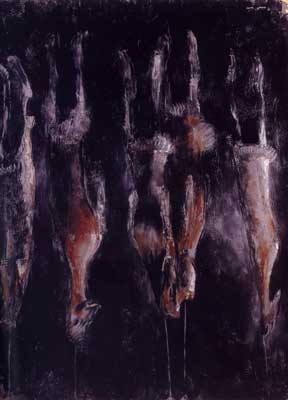
No sooner did Fautrier disentangle from the throes of academicism than the style of paintings took a drastic turn towards abstraction. I lighted on a painting that was to leave in me an equal measure of shock and disturbance as those of the Hostages series. Skins of Rabbits depicts five dead rabbits dangling on a string, their skins torn clumsily from hind paws to heads. Anyone familiar with the tradition of bodegón will surely not consider the work an anomaly in Western Art, nor its luridness too appalling to scrutinise with great concentration. Lurid inevitably one did feel when one judged it for some time, and seemingly saw the trembling fingers of a pair of hands appearing through the forms of the rabbits’ legs. This still-life is not a celebration of food, but Death’s exultant dance.


As Fautrier was inclining towards abstract art, his long pent-up anger and grief burst through the stoical façade that rendered his early works so peculiarly constrained. It was almost of no surprise that Fautrier’s career culminated in the Hostages series. The depictions of victims’ heads- wrung, twisted, fractured, rent, tortured by pain- are rather more of a trenchant response to the horror of war than merely the documenting of personal experiences. Combining figurations with abstractions, the heads are not so unrecognisable as doughs of flesh- one could still dimly make out the physiognomy; the victims were not yet dusting away into oblivion. The affliction is keenly felt yet at times dubiously muted; the emotions ferocious but constrained. A rare beauty exuded from such gruesome aggression when, despite the disconcerting feeling occasioned in me when browsing through the series, I lingered for a while on Fautrier’s sculpture, Head of a Hostage, and fantasised that I saw some obscure face born out of the amorphous rock. Not until when I read Andre Malraux’s exhibition catalogue did I realise I was not entertaining a fantasy, but, according to Monsieur Malraux, the Head, which he singled out as the centerpiece of the series, did entail a hope of “incarnation.”


However I couldn’t help doubting, with one who witnessed and was forced to digest so many horrors and tragedies, Fautrier could still find beauty in ugliness. Maybe at one moment- and let’s imagine if that were the moment before Fautrier breathed his last- he finally realised what human nature was all about: that we are a self-torturing sort, we are born to be forgiving and reconciled with the idiotic conviction that every vice is permitted a chance of redemption. He was tortured not because he was unable to forget, but could never hate.

Saturday, 1 November 2014

News: The original of Caravaggio’s “Mary Magdalen in Ecstasy” might be identified


The original version of Caravaggio’s “Mary Magdalen in Ecstasy,” at least eighteen copies of which are thought to exist, might be finally identified, according to the leading expert on the Baroque master.

After years of arduous quest in search for the real Mary Magdalen in Ecstasy, esteemed scholar and the president of Florence’s Roberto Longhi Art History Foundation, Mina Gregori, declared that she was confident of making an unerring verification of the original version after having studied it at length in a private European collection.

If true, such discovery would surely yield revolutionary importance in Western Art. The version that some experts have claimed as the likeliest original is in a private collection in Rome. Speaking to the Independent, Gregori evaded giving a definite answer as to whether the Rome version was the one she recently authenticated. The only promise she could guarantee was that, with her dogged pressing of the entreaty, the owners of the painting would have it available for public display hopefully in the near future.

So what proof did Gregori have that the painting was indisputably the authentic Caravaggio? She listed off several key characteristics of the painting that helped identify its provenance: “The creation of a body with varying tones, the intensity of the face. The strong wrists, crossed fingers and beautiful hair … the wonderful variations in light and colour.”

Further discovery of a handwritten note that attached to the back of the 103.5 x 91.5 cm painting bolstered its credibility as an original work. In the note, Cardinale Scipione Borghese of Rome, one of the important patrons of Caravaggio’s, was named the commissioner of the painting, which was believed to be conceived in the wake of the artist’s flight from Rome when he was embroiled in a brawl that resulted in him killing a young man.


It wasn’t the first time the name and art of Caravaggio have caused such furore in Western Art. The mystery surrounding the artist is so that some of his paintings have been frequently misattributed or mislabeled. Sothesby’s was recently sued over an alleged misattribution of a painting- The Cardsharps- to a follower of Caravaggio instead of the Italian artist himself. The family of Lancelot Thwaytes first secured the work for £140 in 1962 and sold it to an auction house five decades later in 2006. British collector Sir Denis Mahon, after acquiring the painting at the auction for £42,000, declared it to be an original and thus should be valued at least 10 million. A hearing of the case will be held at High Court on this coming Sunday.


Tuesday, 7 October 2014

Focus: Berenice Abbott


"What the human eye observes casually and incuriously, the eye of the camera notes with relentless fidelity."- Berenice Abbott

There are heads. The display window is teeming with heads; pretty heads. Heads adorned with feathers, fancy wigs, hats. Heads with egg-shaped faces. Faces that are painted with kohl eyes, twirled eyelashes, and rouge lips. Some of the faces are half-concealed with masks; masks that are borrowed from a Venetian masquerade, or an Italian opera. The heads and faces that are so peculiarly beautiful that they can only belong to the mannequins’. The mannequins whose torsos are truncated, who are without bodies. 

Berenice Abbott was reputed for her photographic documentation of New York city. In those photographs Abbott demonstrates her ingenuity in taming the immobile objects. Architecture and various urban constructions are unlike people; they are stubborn and hardened; their dogged immobility is a silent refusal to collaborate with whomever ill-advised enough to approach them like a hunter approaching his prey. But Abbott was a visionary. She detected the animal spirit stirring within the stony heart of every building, and provoked it to burst out of its fossilised shell. Buildings were stimulated into life like animals finally waken from their interminable hibernation. Abbott would approach each of them sometimes with caution, as she hid in the alleyway and only managed to capture a glimpse of its magnificent presence, or aim high her camera when she tackled the towering figure with more boldness. And once she finally conquered the formidable monster like Saint George triumphing over a dragon, she stood atop her conquest and proudly surveying the view beneath her; she would notice the mass of pedestrians that were once bustling her by as she ventured into the heart of the urban forest were now rendered tiny like ants. There is nothing more exhilarating than assuming superiority over those that were once our equivalents.

Abbott’s role as a photographer can be described as a fearless hunter on a mission to hunt down all the peculiar species. But the weapon she used- her camera- was not one designed to inspire fear in the objects she captured. Her intention never seemed to be that of imprisoning into her photographs the city of New York. She was documenting New York without asserting too much authority over her subject matters. Abbott exhibited through her photographs that a good street photographer should always be an unobtrusive observer, ceding lights to the urban vista that is the sole star of the show.

But when it comes to the mannequins, I suppose that even the most preeminent of photographers can be so easily baffled. There is no task more difficult than dealing with something that is constantly in a twilight zone: the mannequins are lifeless dolls with lifelike physiognomy, can appear to be either lifeless or lifelike depending on how one perceives them. Abbott opted for no particular angle in approaching the mannequins, but chose to give them a full-on shot. The moment she pressed her shutter was the moment the mannequins seemed to come alive. Those beautiful faces all decided to violate the demands of their instructor by defiantly turning their heads away from the lens, each of them looking at different directions, responding apathetically of having their pictures taken. Just as the photographer might be miffed at having such recalcitrant prima donnas as her sitters, she unexpectedly succeeded in producing a memorable photograph- eerie, unnerving, menacing.


And not just the line between life and lifelessness, photography unwittingly blurs many more: that between fact and fiction, past and present, subject and object. The disappearance of the line between the subject and the object was precisely the core of Abbott’s photography. Of anything on which we normally attach no more importance than merely a passing notice (an object), through Abbott’s camera it becomes something of a peculiar value (a subject). But once we cherish that photograph as an invaluable work of art, Abbott promptly reminds us that the subject matter can be the most banal of object, which invariably, yet not so astoundingly, fails to leave imprints in our memories. The photographer demonstrates that subject and object can be interchangeable, like mannequins, as well as everything else.

Saturday, 27 September 2014

Focus: Andrew Wyeth

"One generation abandons the enterprise of another like stranded vessels."- Henry David Thoreau, Walden

Andrew Wyeth spoke through the voice of nature. Nature in its most pristine, the least verbose, still retaining that primitive simplicity only the pioneers would know. Wyeth preached the esoteric prophesy; he recounted the mythic tales of the wounded souls, the physically deformed. There is, in his paintings, a nostalgic value that renders his art peculiarly biblical. Modern civilisation is mostly and blissfully omitted; the main feature of the painting is often that of a vast frontier- equable, silent and sparsely peopled. The visionary power of Wyeth’s art is almost comparable to that of the religious paintings. One inexorably has his conscience tugged when seeing Wyeth’s paintings as though one were standing before an altarpiece of Jesus and Madonna.

Interestingly, as though testifying to the obsolescence of his art, Wyeth’s paintings were mostly executed in temperas. The medium confers on his work a feeling of dryness and chalkiness that perfectly evokes the profound spirit of America’s rural past. There is also a sense of flatness that renders the figures as if divested of substance, and would be remedied if the paintings were painted with oil. I wonder if this gave some critics the reason to suggest that Wyeth’s art vacillates between abstraction and realism but, as plenty of medieval altarpieces were as well based on tempera, do we also suppose that this want of three-dimensionality, to which such method of painting is conducive, betrays a tendency towards abstraction? Something seems seriously amiss with such statement that I cannot pinpoint. But I do not recall anyone referring to Giotto’s marvelous religious cycle as tending towards abstraction.

I was initiated into the art of Wyeth through Christina’s World (1948). In it a woman seems to be struggling her way towards the house on all fours. She is half-reclining on a tawny field; the meticulous attention on the details of the grass is superb, one can virtually and clearly discern each individual blade. A feeling of isolation and desertion reigns over this desolate piece. The woman is in reality one named Anna Christina Olson, who had suffered from a muscular deterioration that paralysed her lower body. Apparently Olson was an acquaintance of Wyeth, and the painter must have found her deformity to be peculiarly inspiring, the spectacle of her crawling across the field worth immortalising. Wyeth’s insistence on featuring the helpless Olson into his painting is, to say the least, unnerving. Such disturbing sight, however, whips up one’s sympathy with the woman- to be abandoned on a vast land, to battle on her own without assistance, to be assaulted by fear, apprehension, and unknown danger.


The “tawny field” was to become a leitmotif in Wyeth’s oeuvre. Prior to Christina’s World the presence of the “tawny field” already took central stage in Turkey Pond (1944), which depicts Walt Anderson, a friend of Wyeth, crossing the field towards the pond on the horizon. One hand tucked in the pocket and presumably walking in strides, Anderson exudes no redoubtable fear of the forbidding dominance of nature. Instead his manner bespeaks a proprietary confidence; not one blade of grass will have the impudence to bar his way. Nature is a wild animal already tamed.


Wyeth once underwent a major surgery to remove a portion of his lung.Trodden Weed (1951) was painted during the period of the painter’s convalescence. The painting displays a close-up of Wyeth’s feet, protected by a pair of worn boots, as they stand firmly on the ground, which is overrun with weeds. One senses both feet to be slightly trembling; the merest exertion of putting forth a step appears to be quite an arduous undertaking. In hope of regaining his energy, Wyeth was taking a stroll around Kuerner’s Hill in Chadds Ford, which the painter had frequented since he was young. Nature was his loyal companion, who welcomed Wyeth’s return with the comfort of old familiarity. But nature also hinted at a bleak respect of the painter’s mortality- the grass was trampled flat and smooth under Wyeth’s boots yet they still grew; such potency of resurgence was what the aging Wyeth was denied of.


The narratives of Wyeth’s paintings are deeply personal, yet reflective of a time when the relationship between mankind and nature was one of the least inimical of coexistence. There was no rivalry, no dogged desire of triumphing over the other, no corruption, and men were yet haughty and foolish enough to assume the utmost authority over all living things. Such nostalgia and spirit were, for Wyeth, ones that dwelled in the heart of the American soul.

Monday, 22 September 2014

Focus: Felix Vallotton


"He was there or not there: not there if I didn't see him."- Henry James, The Turn of the Screw

One sees immediately from Felix Vallotton’s paintings that he must had been a gifted raconteur. The painter was possessed of the natural aptitude of unfolding and withholding the narrative flow at the most propitious timing. Mysteriousness emerges. The viewers are bound to be tantalised. Whilst most of Vallotton’s paintings are about the quotidian, the domestic, beneath them their pent-up energy seethes and trembles, threatening to explode at any moment. It isn’t just the quotidian that he depicted, but the interior dramas. Any reader of Ibsen’s or Strindberg’s plays will know that interior drama can be the most frenetic.

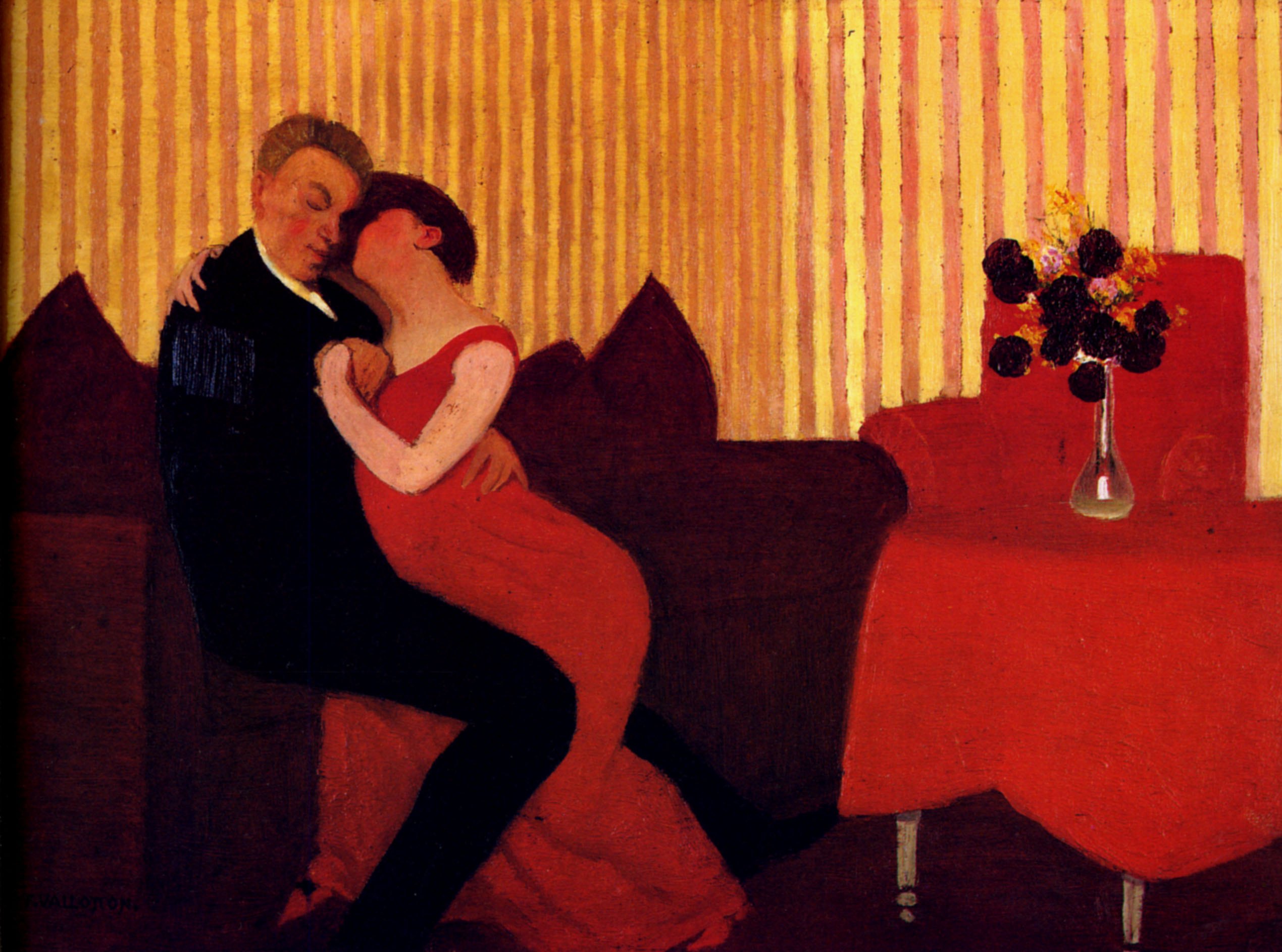
A woman leans towards a man, her hand entwines his body in show of sensuousness. She whispers into his ears something that the viewers are forbidden the right to privy to. But one has the eye to deduce, from the slightly wrinkled of the man’s nose and the slightly arched of his eyebrow, that the message she confides to him seems to be one that pricks his annoyance. Or is it? One quickly retracts on his original conjecture. Or could it be that the man is actually smiling, made amused by his lover’s sweet nothings. Or is it rather a hackneyed episode of the deceiver and the deceived, but is the latter always so blind to the trap he is about to fall into? Perhaps not so much as his face intimates his mistrust to the woman’s flattering words. Gradually one grows fretful of so many possible answers to an ever-unsolvable question, especially under the likelihood that not even one of them accurately squares with the painter’s real intention. Therefore, out of sheer frustration, one will declare that a painting like The Lie (1989) is “rather baffling.”


Vallotton died in 1925 and left a total of over 1700 paintings and 200 prints. With such a gross oeuvre it was rather difficult to maintain the consistent quality of each individual work. The tense feeling of emotional suspense in The Lie can stiffen into that of rigid formality in other paintings. Once Vallotton decided to simplify the contours of figures and skimp on the varying use of colours of his palette, the result can be so plausibly namby-pamby. This criticism is, however, not also targeting at those Japonist-inspired landscape paintings. Examples like Sunset (1913), with its compositional simplification, achieves an effect both pleasing and spiritual. An orange-red sun hangs at the centre of the painting. The sunbeam stretches vertically across the ocean, towards the viewers. What can the symbolic meaning be? The presence of God in the form of light? Or it denotes the fateful path every devout believer must embark upon to assume connection with the deities?


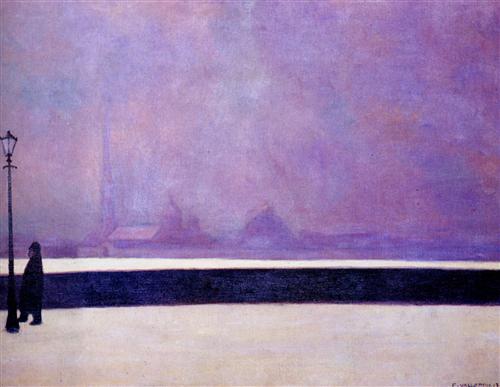
Vallotton’s later work, though exhibiting an obvious tendency towards abstraction, boasts the richest and the most suspenseful of dramas in its storytelling. Everything seems to be perfectly normal; nothing seems to be going on, whilst one suspects that something queer is indeed afoot. There is this painting that is dominated almost wholly with a bland, monotonous landscape: snow field, straight avenue, some houses that are hidden behind the heavy mists, a wobbly lamppost, and no more. A man is at the edge of the painting, hastening out of the frame. Going where? One never knows. But one can sense that he might be quite desperate to get out of this place, this deserted town that seems only frequented by the old spirits. Here lies the most ingenious aspect of Vallotton’s creativity: to keep ablaze the fire of intriguing drama even though the subject matter seems to revolve on the most dismal, the most desolate. He never gratified his viewers more than a glimpse of what they were most desirous of. And that is the key to the most masterful of storytelling in art.